
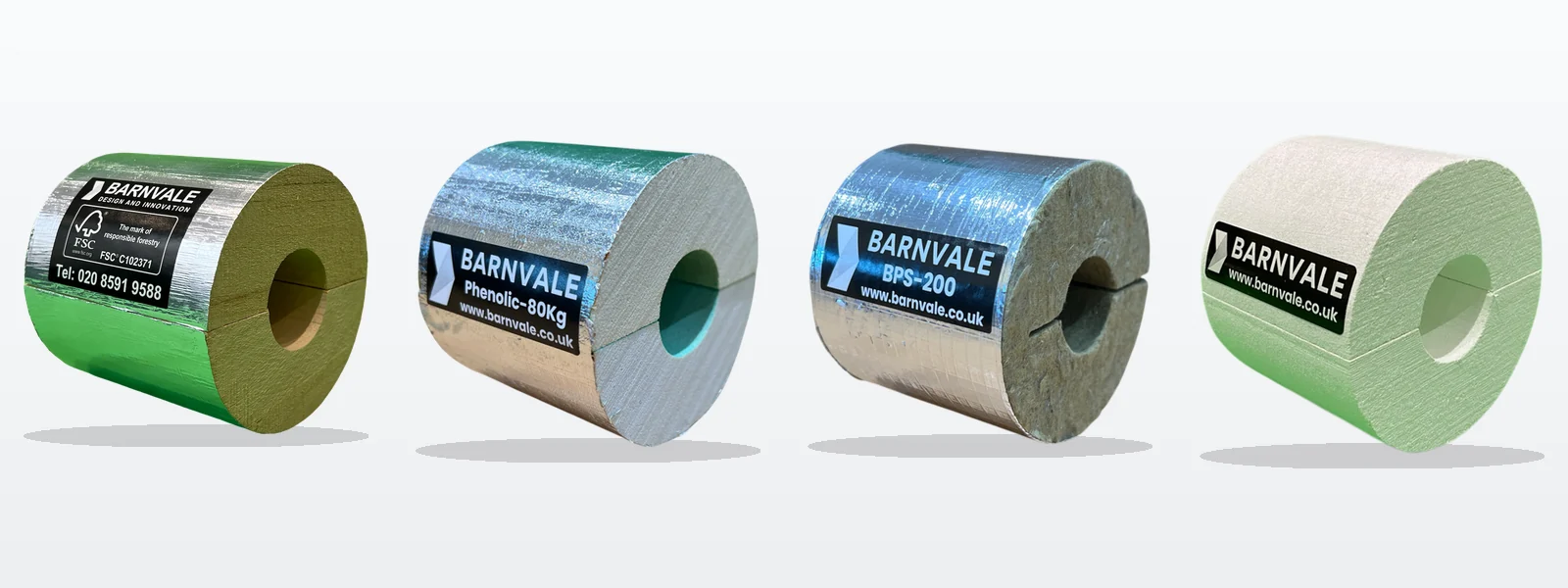
Key takeaways
- Pipe insulation blocks carry the pipe’s load at each support while keeping the insulation continuous.
- On chilled pipework they stop condensation forming at the clip. On heating pipework they cut heat loss.
- The right block depends on operating temperature, load, thermal performance and the project specification.
- Size the block to the pipe’s outside diameter and the insulation thickness, then size the clip to the block.
Every insulated pipe has a weak point wherever it meets a pipe clip. Clamp the clip straight onto the pipe and the insulation is broken. Clamp it over the insulation and the insulation is crushed. Pipe insulation blocks solve both problems. This guide explains what they do, compares the main block materials and sets out what to check when choosing one.
What are pipe insulation blocks?
Pipe insulation blocks, also called insulated pipe supports or load-bearing insulation blocks, are rigid, pre-formed insulating sections that fit around the pipe at each support point. The pipe clip fits around the outside of the block, so the block carries the load from the pipe into the support while the insulation runs continuously along the pipe.
Blocks are usually supplied in two halves. They are sized to the pipe’s outside diameter and made to the same thickness as the surrounding insulation, so the lagging butts neatly up to each side. Most have a foil or vapour-barrier facing so they can be sealed into the insulation system.
Why insulated pipe supports matter
Preventing condensation on chilled pipework
Where a metal clip touches a chilled water pipe, it creates a cold bridge. Moisture in the air condenses on the cold surface, which can lead to dripping, corrosion, damaged insulation and stained ceilings below. A sealed insulation block keeps the cold surface away from the warm, moist air.
Reducing heat loss on heating pipework
On LTHW, steam and other hot services, every uninsulated support point loses energy for as long as the system runs. Across a large building, hundreds of support points add up.
Protecting the insulation
Standard pipe insulation is not designed to carry a load. All supports should be via a load-bearing block.
The main types of pipe insulation block
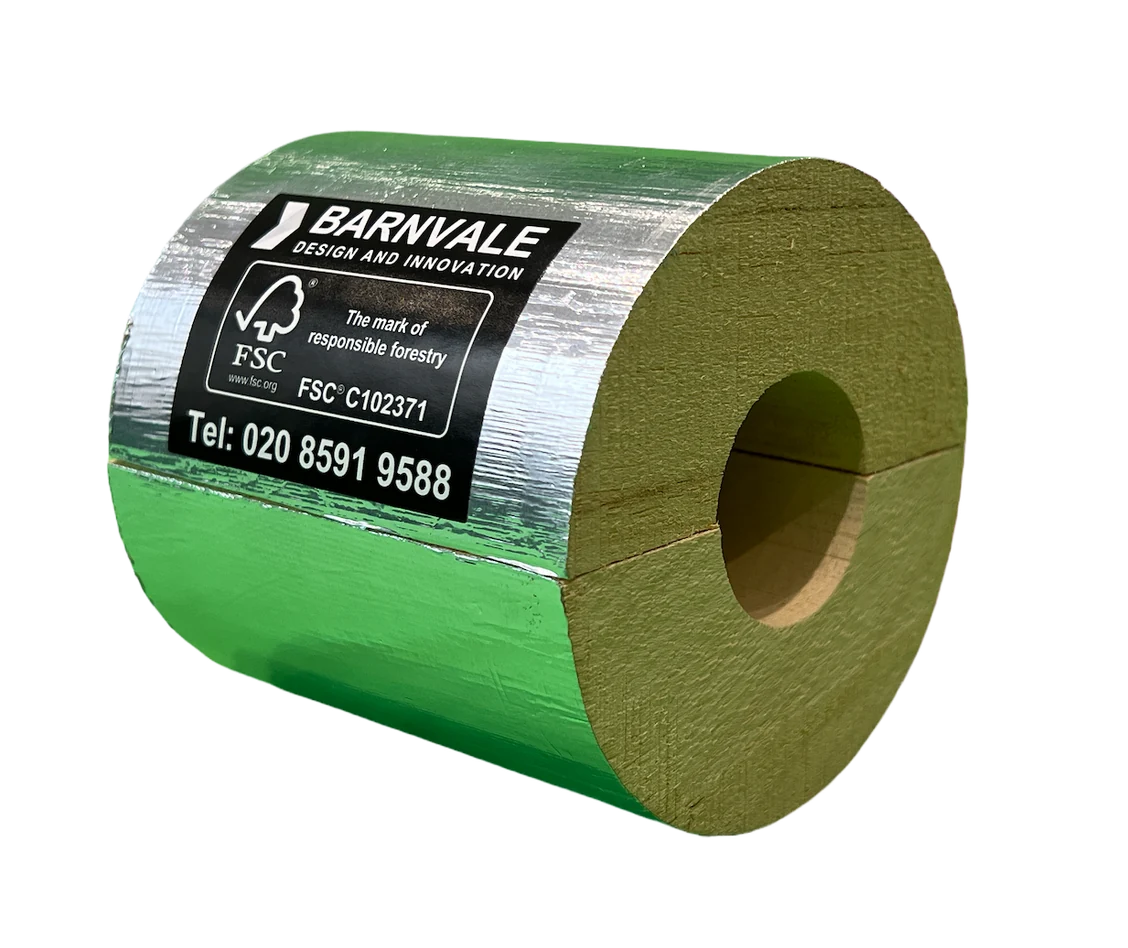
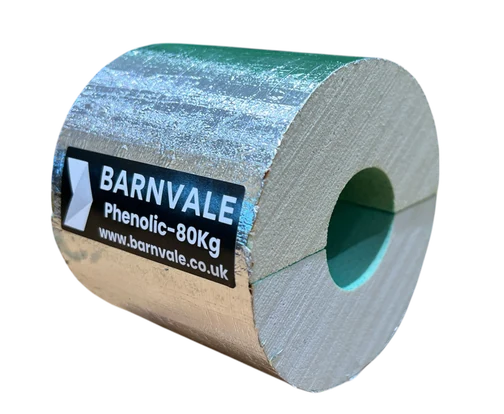
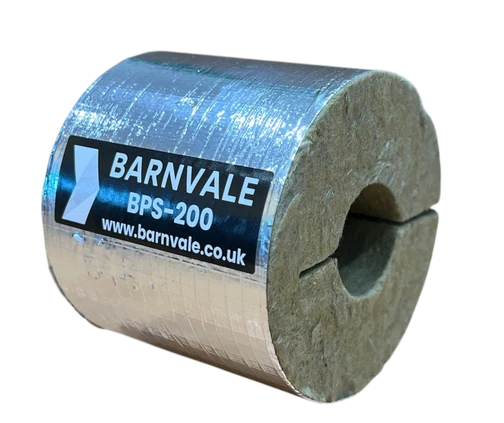
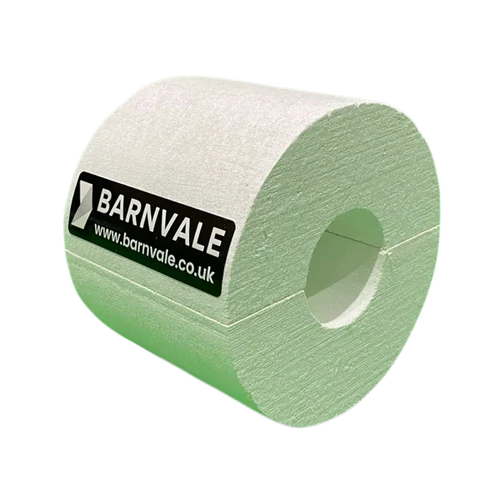
FSC®-certified Hardwood blocks
Hardwood blocks are a long-established choice with a high load capacity, making them well suited for heavier pipework and highly loaded support points. When cut with an oversized bore, they can also accommodate close-guided axial pipework movement, where other materials wear down over time (particularly lower-density blocks). Barnvale manufactures FSC®-certified Hardwood blocks in-house, so the timber comes from responsibly managed sources. This helps on projects with sustainability or chain-of-custody requirements. Hardwood is less thermally efficient than the foam materials, so check that it meets the project’s thermal requirements, particularly on chilled water.
Phenolic blocks, including Kingspan Kooltherm
Phenolic foam has very low thermal conductivity, so Phenolic blocks give some of the best thermal performance of any block material. They are widely used on chilled water and heating services and come in different densities, so a higher-density block can be chosen where the load is higher. Barnvale supplies Phenolic blocks, including Kingspan Kooltherm blocks.
Stonewool blocks: BPS-200 and Rocklap
Stonewool is non-combustible, so Stonewool blocks suit heating and higher-temperature services and areas where fire performance is a priority. They are often used with Stonewool pipe insulation to keep the system consistent. Barnvale supplies BPS-200 and Rocklap Stonewool blocks.
Calcium Silicate blocks
Calcium Silicate is a rigid, non-combustible material with high compressive strength. It is suited to high operating temperatures, which is why it is often chosen for steam and high-temperature hot water pipework. Barnvale manufactures Calcium Silicate blocks in-house.
Hybrid blocks
Hybrid blocks combine materials in a single block, typically pairing a high-strength load-bearing section with a more thermally efficient insulating material. The result balances load capacity and thermal performance where a single material would be a compromise. Barnvale manufactures Hybrid blocks in-house and can advise on the right combination for a support detail.
| Block type | Typical services | Main strengths | Points to check |
|---|---|---|---|
| FSC® Hardwood | Chilled and heating, especially for heavier load cases | High load capacity, responsibly sourced timber | Lower thermal performance than foam blocks |
| Phenolic | Chilled water and heating | Excellent thermal performance, density options | Choose the density to suit the load |
| Stonewool | Heating, higher temperatures, fire-sensitive areas | Non-combustible, matches Stonewool insulation | Confirm the load rating on heavier pipework |
| Calcium Silicate | Steam and high-temperature hot water | High temperatures, high compressive strength | Rigid material, so handle with care on site |
| Hybrid | Supports needing both strength and insulation | Balances load capacity and thermal performance | Specify the combination for the detail |
Always confirm temperature ranges and load ratings against the product data sheet for the block you are specifying.
How to choose the right pipe insulation block
- Operating temperature. Start with the service: chilled water, heating, or high-temperature and steam. Check the block’s temperature range on its data sheet.
- Load at the support. The block must carry the weight of the pipe, its contents and the insulation, plus any other loads at that point, without crushing. Pipe size, support spacing and the support type (clip, roller, guide or anchor) all affect the load.
- Thermal performance. On chilled services the priority is preventing condensation, so the block should perform at least as well as the insulation around it. On heating services it cuts heat loss at every support.
- Vapour sealing. On chilled pipework, the block’s vapour barrier must be sealed to the insulation’s vapour barrier. Any gap lets moisture in, and condensation follows.
- Fire performance and specification. Check the project specification, the fire strategy and the insulation standard the project follows, such as BS 5422, and choose a block that is compatible with them.
- Sustainability. Where the project calls for certified timber, choose FSC®-certified Hardwood blocks supplied with the correct chain-of-custody claim.
Getting the size right
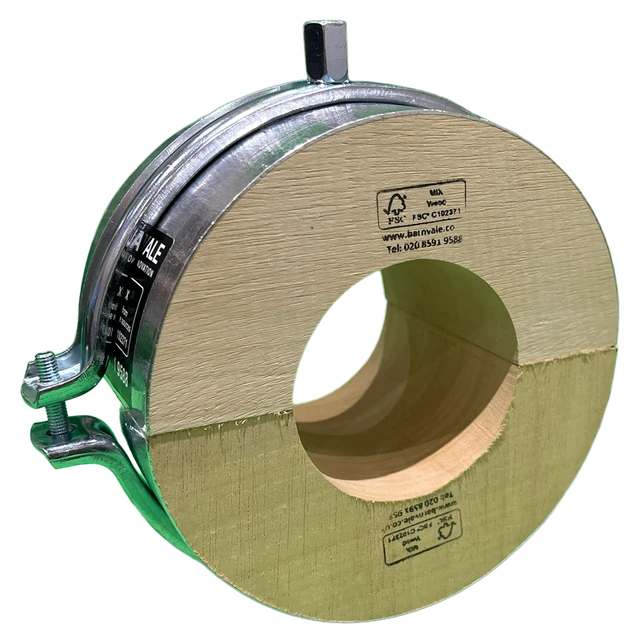
Three dimensions matter: the pipe’s outside diameter, the insulation thickness and the block length.
- Bore: match it to the actual outside diameter of the pipe. This varies between steel, copper, stainless steel and plastic pipe of the same nominal size.
- Thickness: match it to the insulation so the finish is flush and the vapour barrier can be sealed.
- Clip: size it to the outside diameter of the block. Barnvale’s split band clips are made to suit insulation for exactly this reason. Our Block & Clip Selector works out the block OD and clip size for you.
For sizes at a glance, see our pipe clip size chart for insulated pipe.
Where blocks sit on rollers, slide guides or skids, sheet-metal sleeves protect the block and help spread the load. Barnvale supplies sheet-metal sleeves to suit its blocks.
Common mistakes to avoid
- Running standard pipe insulation through the support instead of fitting a load-bearing block.
- Ordering blocks by nominal pipe size instead of the actual outside diameter.
- Using a block thinner than the surrounding insulation.
- Leaving the vapour barrier unsealed at block joints on chilled services.
- Fitting a clip sized to the pipe rather than to the block.
Frequently asked questions
Do I need an insulation block at every pipe support?
On insulated chilled and heating pipework, a load-bearing insulated support is normally needed at each support point so the insulation is not broken or crushed. Always check the project specification.
Which pipe insulation block is best for chilled water?
FSC® Hardwood is the common choice for chilled water services. The right choice depends on the load, the specification and how the vapour barrier will be sealed.
Which pipe insulation block is better suited for LTHW expansion?
FSC® Hardwood blocks with an oversized internal bore allow close-guided axial pipework movement. They are increasingly being used in place of Phenolic blocks because they do not wear down. Phenolic blocks wear from pipework friction as the pipe moves thermally, commonly deforming the bottom block at the support. Hardwood remains stable and gives greater longevity.
What information do I need to order pipe insulation blocks?
Send us the pipe type (steel, copper, stainless steel, etc.), the pipe size (outside diameter in mm), the insulation thickness required, the operating conditions (such as temperature) and any other specification or mandatory requirements (for example outdoor use, or whether sleeves are required). Also let us know the support the blocks need to suit, such as lightweight clips or split band clips, and we will quote and supply blocks sized to suit.
Need help choosing a block?
Barnvale manufactures FSC® Hardwood, Calcium Silicate and Hybrid insulation blocks in-house, and supplies Phenolic and Stonewool blocks to suit. Send us your pipe sizes, insulation thickness and service and we will recommend the right block.